 |
SyterKit 0.4.0.x
SyterKit is a bare-metal framework
|
Loading...
Searching...
No Matches
|
SyterKit 0.4.0.x
SyterKit is a bare-metal framework
|
#include <stdarg.h>#include <stdbool.h>#include <stddef.h>#include <stdint.h>#include <string.h>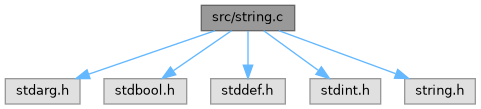
Functions | |
| unsigned int | strlen (const char *str) |
| Calculates the length of the string 'str', excluding the terminating null byte. | |
| unsigned int | strnlen (const char *s, unsigned int n) |
| Calculates the length of the string 's', but not more than 'n' characters. | |
| char * | strcpy (char *dst, const char *src) |
| Copies the string pointed to by 'src', including the terminating null byte, to the buffer pointed to by 'dst'. | |
| char * | strcat (char *dst, const char *src) |
| Appends the string pointed to by 'src', including the terminating null byte, to the end of the string pointed to by 'dst'. | |
| int | strcmp (const char *p1, const char *p2) |
| Compares the string pointed to by 'p1' to the string pointed to by 'p2'. | |
| int | strncmp (const char *p1, const char *p2, unsigned int cnt) |
| Compares at most the first 'cnt' characters of the string pointed to by 'p1' to the string pointed to by 'p2'. | |
| char * | strchr (const char *s, int c) |
| Finds the first occurrence of the character 'c' (converted to a char) in the string pointed to by 's', including the terminating null byte. | |
| char * | strrchr (const char *s, int c) |
| Finds the last occurrence of the character 'c' (converted to a char) in the string pointed to by 's', including the terminating null byte. | |
| char * | strstr (const char *s1, const char *s2) |
| Finds the first occurrence of the substring 'what' in the string 's'. | |
| void * | memchr (void *src, int val, unsigned int cnt) |
| Locates the first occurrence of the character 'value' (converted to an unsigned char) in the first 'num' bytes of the memory area pointed to by 'ptr'. | |
| char * | strncpy (char *dest, const char *src, unsigned int n) |
| Copies up to 'n' characters from the string pointed to by 'src', including the terminating null byte, to the buffer pointed to by 'dest'. | |
| void * | memmove (void *dst, const void *src, unsigned int cnt) |
| Copies 'count' bytes from the memory area 'src' to the memory area 'dest'. | |
| void * memchr | ( | void * | ptr, |
| int | value, | ||
| unsigned int | num | ||
| ) |
Locates the first occurrence of the character 'value' (converted to an unsigned char) in the first 'num' bytes of the memory area pointed to by 'ptr'.
| ptr | The input memory area. |
| value | The value to search for. |
| num | The number of bytes to examine. |
| void * memmove | ( | void * | dest, |
| const void * | src, | ||
| unsigned int | count | ||
| ) |
Copies 'count' bytes from the memory area 'src' to the memory area 'dest'.
The memory areas may overlap.
| dest | The destination memory area. |
| src | The source memory area. |
| count | The number of bytes to copy. |
| char * strcat | ( | char * | dst, |
| const char * | src | ||
| ) |
Appends the string pointed to by 'src', including the terminating null byte, to the end of the string pointed to by 'dst'.
| dst | The destination string. |
| src | The source string. |
| char * strchr | ( | const char * | s, |
| int | c | ||
| ) |
Finds the first occurrence of the character 'c' (converted to a char) in the string pointed to by 's', including the terminating null byte.
| s | The input string. |
| c | The character to search for. |
| int strcmp | ( | const char * | p1, |
| const char * | p2 | ||
| ) |
Compares the string pointed to by 'p1' to the string pointed to by 'p2'.
| p1 | The first string to compare. |
| p2 | The second string to compare. |
| char * strcpy | ( | char * | dst, |
| const char * | src | ||
| ) |
Copies the string pointed to by 'src', including the terminating null byte, to the buffer pointed to by 'dst'.
| dst | The destination buffer. |
| src | The source string. |
| unsigned int strlen | ( | const char * | str | ) |
Calculates the length of the string 'str', excluding the terminating null byte.
| str | The input string. |
| int strncmp | ( | const char * | p1, |
| const char * | p2, | ||
| unsigned int | cnt | ||
| ) |
Compares at most the first 'cnt' characters of the string pointed to by 'p1' to the string pointed to by 'p2'.
| p1 | The first string to compare. |
| p2 | The second string to compare. |
| cnt | The maximum number of characters to compare. |
| char * strncpy | ( | char * | dest, |
| const char * | src, | ||
| unsigned int | n | ||
| ) |
Copies up to 'n' characters from the string pointed to by 'src', including the terminating null byte, to the buffer pointed to by 'dest'.
| dest | The destination buffer. |
| src | The source string. |
| n | The maximum number of characters to be copied. |
| unsigned int strnlen | ( | const char * | s, |
| unsigned int | n | ||
| ) |
Calculates the length of the string 's', but not more than 'n' characters.
| s | The input string. |
| n | The maximum number of characters to examine. |
| char * strrchr | ( | const char * | s, |
| int | c | ||
| ) |
Finds the last occurrence of the character 'c' (converted to a char) in the string pointed to by 's', including the terminating null byte.
| s | The input string. |
| c | The character to search for. |
| char * strstr | ( | const char * | s, |
| const char * | what | ||
| ) |
Finds the first occurrence of the substring 'what' in the string 's'.
| s | The input string. |
| what | The substring to search for. |
 1.9.8
1.9.8