 |
SyterKit 0.4.0.x
SyterKit is a bare-metal framework
|
Loading...
Searching...
No Matches
|
SyterKit 0.4.0.x
SyterKit is a bare-metal framework
|
#include <io.h>#include <stdarg.h>#include <stdbool.h>#include <stddef.h>#include <stdint.h>#include <types.h>#include <sys-clk.h>#include <sys-dma.h>#include <sys-gpio.h>#include <log.h>#include <reg-spi.h>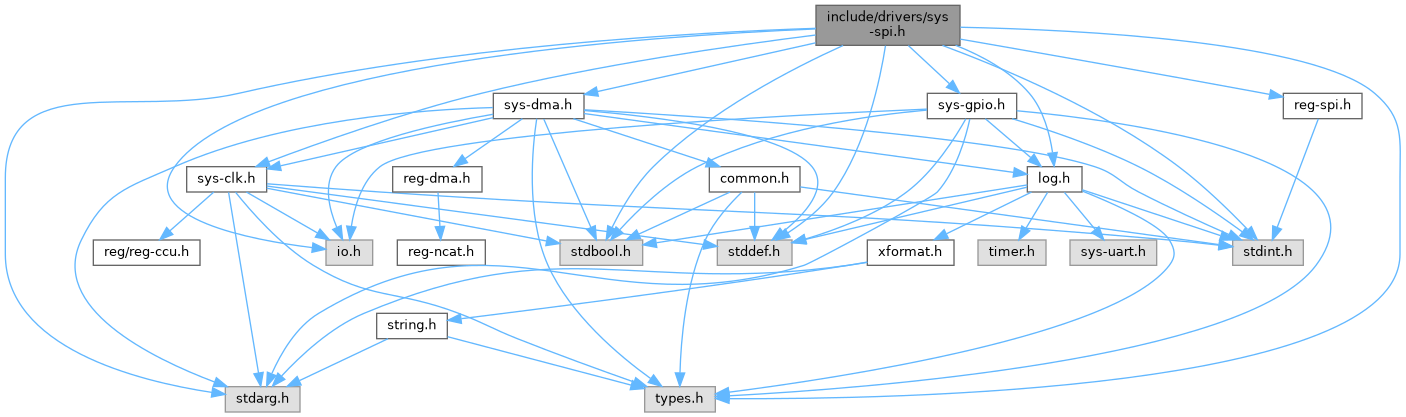
Go to the source code of this file.
Classes | |
| struct | sunxi_spi_gpio_t |
| SPI GPIO Configuration Structure. More... | |
| struct | sunxi_spi_clk_t |
| SPI Clock Configuration Structure. More... | |
| struct | sunxi_spi_t |
| SPI Device Configuration Structure. More... | |
Macros | |
| #define | MAX_FIFU (64) |
| Maximum FIFO size set to 64. | |
| #define | SPI_CLK_SEL_PERIPH_300M (0x1) |
| Selects the SPI peripheral clock to 300 MHz. | |
| #define | SPI_CLK_SEL_PERIPH_200M (0x2) |
| Selects the SPI peripheral clock to 200 MHz. | |
| #define | SPI_CLK_SEL_FACTOR_N_OFF (8) |
| Offset for the SPI clock select factor is 8. | |
| #define | SPI_DEFAULT_CLK_RST_OFFSET(x) (x + 16) |
| Returns the default clock reset offset, based on the SPI module number (x). | |
| #define | SPI_DEFAULT_CLK_GATE_OFFSET(x) (x) |
| Returns the default clock gate offset, based on the SPI module number (x). | |
Enumerations | |
| enum | spi_io_mode_t { SPI_IO_SINGLE = 0x00 , SPI_IO_DUAL_RX , SPI_IO_QUAD_RX , SPI_IO_QUAD_IO } |
| SPI Input/Output Mode Enumeration. More... | |
| enum | spi_speed_mode_t { SPI_LOW_FREQUENCY = 24000000 , SPI_MOD_FREQUENCY = 50000000 , SPI_HIGH_FREQUENCY = 60000000 , SPI_MAX_FREQUENCY = 100000000 } |
| SPI Speed Mode Enumeration. More... | |
| enum | spi_clk_cdr_mode_t { SPI_CDR1_MODE = 0 , SPI_CDR2_MODE = 1 , SPI_CDR_NONE = 2 } |
| SPI Clock CDR Mode Enumeration. More... | |
Functions | |
| int | sunxi_spi_init (sunxi_spi_t *spi) |
| Initializes the SPI interface. | |
| void | sunxi_spi_disable (sunxi_spi_t *spi) |
| Disables the SPI interface. | |
| int | sunxi_spi_update_clk (sunxi_spi_t *spi, uint32_t clk) |
| Updates the SPI clock rate. | |
| int | sunxi_spi_transfer (sunxi_spi_t *spi, spi_io_mode_t mode, void *txbuf, uint32_t txlen, void *rxbuf, uint32_t rxlen) |
| Performs SPI data transfer. | |
| #define MAX_FIFU (64) |
Maximum FIFO size set to 64.
| #define SPI_CLK_SEL_FACTOR_N_OFF (8) |
Offset for the SPI clock select factor is 8.
| #define SPI_CLK_SEL_PERIPH_200M (0x2) |
Selects the SPI peripheral clock to 200 MHz.
| #define SPI_CLK_SEL_PERIPH_300M (0x1) |
Selects the SPI peripheral clock to 300 MHz.
| #define SPI_DEFAULT_CLK_GATE_OFFSET | ( | x | ) | (x) |
Returns the default clock gate offset, based on the SPI module number (x).
| #define SPI_DEFAULT_CLK_RST_OFFSET | ( | x | ) | (x + 16) |
Returns the default clock reset offset, based on the SPI module number (x).
| enum spi_clk_cdr_mode_t |
| enum spi_io_mode_t |
SPI Input/Output Mode Enumeration.
This enum defines the different SPI I/O modes.
| enum spi_speed_mode_t |
| void sunxi_spi_disable | ( | sunxi_spi_t * | spi | ) |
Disables the SPI interface.
This function disables the SPI bus, deinitializes DMA (if used), and deinitializes the SPI clock. It is called when the SPI interface is no longer needed or when performing cleanup operations.
| spi | Pointer to the SPI structure containing configuration and register information. |
| int sunxi_spi_init | ( | sunxi_spi_t * | spi | ) |
Initializes the SPI interface.
This function initializes the SPI interface by configuring the GPIO pins, clock, bus, and counters. If a DMA handle is set, DMA mode is used for data transfers. The function calls several other SPI initialization functions to set up the SPI hardware.
| spi | Pointer to the SPI structure containing configuration and register information. |
| int sunxi_spi_transfer | ( | sunxi_spi_t * | spi, |
| spi_io_mode_t | mode, | ||
| void * | txbuf, | ||
| uint32_t | txlen, | ||
| void * | rxbuf, | ||
| uint32_t | rxlen | ||
| ) |
Performs SPI data transfer.
This function initiates a data transfer on the SPI bus. The transfer can be either full-duplex (both transmission and reception) or half-duplex (only transmission or reception). The transfer is done based on the specified SPI I/O mode. The function handles both transmit and receive operations, including the use of DMA if required for large transfers.
| spi | Pointer to the SPI structure containing configuration and register information. |
| mode | The I/O mode to use for the transfer (e.g., single, dual, quad). |
| txbuf | Pointer to the transmission buffer. |
| txlen | Length of the transmission data in bytes. |
| rxbuf | Pointer to the reception buffer. |
| rxlen | Length of the reception data in bytes. |
| int sunxi_spi_update_clk | ( | sunxi_spi_t * | spi, |
| uint32_t | clk | ||
| ) |
Updates the SPI clock rate.
This function updates the SPI clock rate and reinitializes the clock, bus, and transfer control settings to apply the new clock rate.
| spi | Pointer to the SPI structure containing configuration and register information. |
| clk | The new clock rate to be set. |
 1.9.8
1.9.8